To skip
the SAS overview, click one of the below links.
LATEST NEWS! CLICK HERE
For Dr Stern's SAS study
submission information click HERE
For an explanation of SAS diagnosis by "velocity" only (no SAS defect
on
echo) click HERE
For Breeding
Recommendations click HERE
For
Darla's diet information click HERE

ABOUT SUB AORTIC STENOSIS IN ROTTWEILERS
Sub Aortic
Stenosis (SAS) is the
most
common congenital heart defect in Rottweilers.
Rottweilers
are affected with SAS on all continents and almost all bloodlines.
Many of the presumed heat stroke or poisoning deaths are later found
(if a necropsy is done) to have been SAS deaths.
SAS
involves the narrowing of the out-flow tract from the left ventricle
leading to the aorta. When there is a narrowing of
the
tract, the heart must pump harder to get blood through the smaller
opening. As the SAS-affected dog matures, his/her heart develops a
thicker muscle to push harder, which (in
moderate to severly affected dogs) leads to an irregular heart
beat, a lack of blood to the heart, congestive heart failure, or sudden
death.
SAS is diagnosed in living dogs by a cardiologist performing a
dopplar echocardiograph exam of dogs.
Severe
cases can often be tentatively diagnosed by auscultation.
Practitioner exams even if by echo are NOT definitive!
Note
that sedation or anesthesia is detrimental to accurate evaluation.
SAS can be diagnosed by a cardiologist based upon
narrowing, a ridge, velocity or all three. You don't need all three to
be diagnosed with SAS, some dogs only have ONE at the time of
evaluation.
Also, dogs can pass an auscultation exam and fail an echo; they can
also fail an auscultation but then pass the echo when it clears dog of
defect (innocent murmur not congenital/heritable)
Echo is essential.
Research
is indicating that
the mode of heritability can vary by breed, and originate at different
gene locations. For example Newfoundand SAS is a totally different gene
location than Golden Retrievers and Rottweilers.
NEWS
New 10/2023
Subvalvular
Aortic Stenosis: Learning From Human and Canine Clinical Research
Amanda
E Crofton, Samantha
L Kovacs, Joshua
A Stern
******************************
Feb 2019-
Sas update from Dr Sterns.
Sas is “looking” to be recessive in Rottweilers , Bullmastiffs and
Goldens
Yes, recessive
Here’s my notes from a follow up conversation with Dr Stern
1- pattern of inheritance really does not matter until we have DNA
test.
Any dog that is part of a pair that produces one should be assumed part
of the process (recessive or dominant variable penetrance)
2- vet cardiologist are not all using
most modern equipment or
techniques. So not all are equal. The newer OFA advanced cardiac form
helps
but not totally
3- velocities
- *If lvot/ aortic velocity reading is taken subcostal (under
ribs with the probe pointing forward )
then anything under 2.0 m/s is acceptable.
*If lvot/aortic velocity reading is taken Apical (not taken
subcostal ) then lower velocities are desired.
*Lvot/aortic velocity taken subcostal (under ribs) will only rarely be
under 1.7
(I’m not changing my personal velocity criteria (1.7 or
below)
but
I’m giving you this info)
4- in some pedigrees if recessive but common it can appear as if
dominant
even if it’s not.
His exact words “Remember that if the gene is common in the carrier
state, then a recessive disease can look dominant in some pedigrees”
5- yes there can be two types of SAS like in newfoundlands. No
guarantee that what they’ve
seen for SAS in Rottweilers is the only type in the breed, but all he’s
seen in his samples indicate
a single recessive type is most likely
6- continue to echo ALL breeding dogs until a DNA test comes
out
AND try to make sure the lvot/aortic velocity is taken subcostal (below
ribs) In these cases
(readings were taken subcostal)all dogs under 2.0 m/s can be used but
if they produce sas realize they
likely carry it and change your plans for those dogs
7- if lvot/aortic velocity is apical (not subcostal) or you don’t know
method used, then 1.7
and below is a reasonable
safe goal. Since you are unlikely to know how a dog was echo'ed I would
personally maintain THIS CRITERIA!
8- when planning breedings, keep the fact that sas is likely recessive
in mind
*do a pedigree analysis and research, looking for affected dogs
,
*patterns (some popular dogs clearly throw lots of sas),
*use only
echoed breeding dogs
* consider all dogs that throw sas as a probable carrier
9- continue to submit samples to the study and hope the DNA marker for
testing is found soon
To submit a sample contact lab at link lower down on this page
Read the full published study article here
Congenital Cardiac Outflow Tract
Abnormalities in Dogs: Prevalence and pattern of Inheritance from
2008-2017
Also
read :
These
are the single
hardest "grades" or
"diagnosis" to accept.
To have your dog graded as Equivocal or
worse,
affected with mild SAS
and yet the cardiologist tells you the heart looked and sounded perfect
on echo, with perhaps very slight aortic insufficency, aortic regurge,
turbulance etc.
and that your dog would have PASSED a simple auscultation exam. So you
get a grade you never expected. HOW can this be you want to know?!
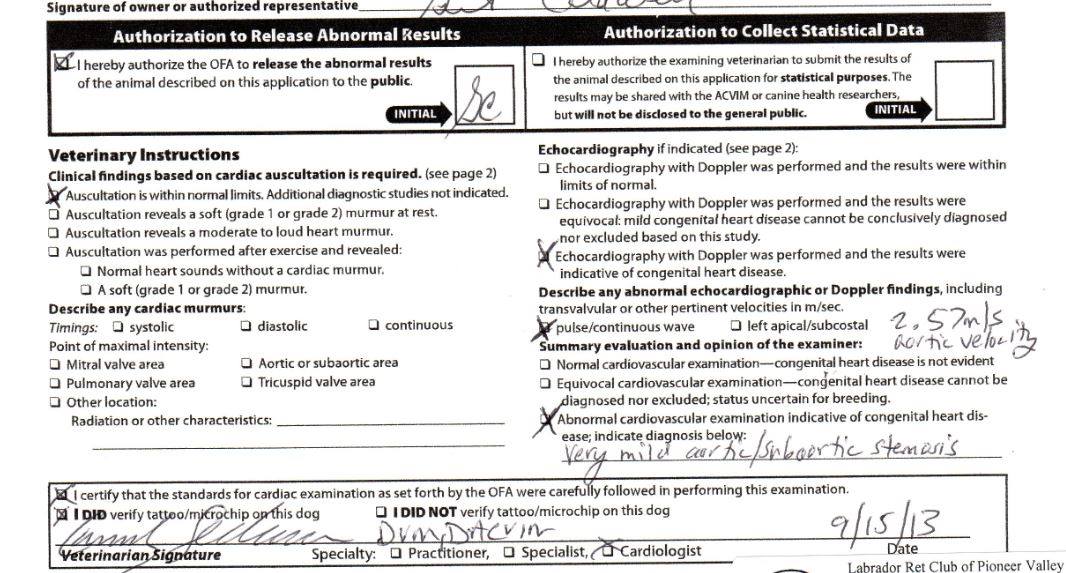
The facts are
simply that the
equipment we
currently
have is not
sensitive enough to image all the tiny defects, BUT research and
necropsies HAVE proven that these elevated velocities- especially when
accompanied by aortic insufficiency, aortic regurge, turbulance etc-
really are extremely
slight affected dogs.
IF you were to open your dog's heart up,
you would
be able to see the
miniscule defects (and in a test breeding Newfoundland study they did
just that, sacrificed some of the animals produced and examined the
hearts).
THIS is why I am such a STRONG advocate
of breeding
Rottweilers (and
preferably all Rottweilers having heart certifications done) being
echoed BECAUSE auscultations can and do MISS mild and equivocal
affected dogs!!!
Dr J. Stern has given me this short
quote sums up the above facts:
"a
device that images from outside the heart could never be as accurate as
looking directly at the inside of the heart. As such, The
presence of a subvalvular ridge on echo is not a requirement for
diagnosis of mild or equivocal SAS. Simply the velocity has
been
used by cardiologists for years."
Dr
K. Meurs & Dr J. Stern
have conducted U.S.
studies for the
Golden
Retrievers,
Newfoundlands and Boxer breeds. Dr Meurs conducted a very limited
retrospective pedigree study for
Rottweilers through the RHF (Rottweiler Health Foundation) but this
study was hampered by a serious LACK of participants. Since I receive
calls and emails monthly from owners of afflicted dogs I KNOW this was
not caused by a lack of incidence of SAS in our breed. Instead the lack
of participation is directly linked to the number of breeders/owners
who
decline to participate!
Dr Stern is
currently collecting blood samples
from both
affected
(as
diagnosed by Cardiologist echo) and cardiologist echo clear dogs (proof
of
clear being an OFA certificate showing the C-ECHO suffix or a
cardiologist report) and they have
began a DNA evaluation of these samples
Preliminary findings are
that the gene(s)
is/are probably
similar as that which afflicts Golden Retrievers (but not the SAME one)
and the
likely on just a single chromosome.
A DNA test for this is
highly likely, IF
steady funding of the
research happens.
The Newfoundland breed got a test for ONE of their SAS variants because
of
steady, generous funding AND participation. One Newfoundland study had
6,000 dogs participating! Rottweiler people are FAR less likely to
donate samples or money.
Rottweiler Familial Subaortic Stenosis
Study
They are currently
STILL looking
for DNA samples
from
Rottweilers
with
a diagnosis of Subvalvular aortic stenosis diagnosed by
Doppler
echocardiogram
or
Normal by cardiologist performed Doppler echocardiogram
to advance their study to
identify a gene for the disease.
Of particular interest,
Samples from Families of Rottweilers with echo normal parents, at least
one affected offspring ,plus normal by echo offspring.
As Dr Stern has moved the study back to NCSU, Contact Stern Lab at:
Stern
Genetics Laboratory
NC State University
1051 William Moore Drive
Research Building Room 318A
Raleigh, NC 27607
Please
return
THIS form with your sample and
documentation/reports
SAS Testing
Doppler
echo
by a board certified cardiologist is the GOLD STANDARD and
best screening tool we CURRENTLY have UNTIL a DNA test is developed.
SAS is a variable expression condition with only a phenotypic test.
Variable expression traits are
very hard for breeders to grasp,
especially when those traits/ diseases have no genetic test.
Here are some traits that are variable
expression that we DO HAVE genetic tests for:
*Short
coat. Expression can range
from a tight slick coat to a heavy coat 2+" long with haunch and belly
fringe and a longer neck ruff.
* Long
coat. Expression ranges
from a coat visually similar to a heavy short coat, all the way up to a
show Newfoundland, Rough collie or Old English sheepdog length.
*Furnishings. (wire beards etc)
range from completely undetectable visually on up to a heavy bearded,
brows, leg fringe, stand off wire body coated dog.
Hip dysplasia and SAS are both conditions that are variable expression,
with phenotypic testing only- no currently available accurate
genetic test.
What are Phenotypic tests?
Phenotypic tests are tests that diagnose
dogs based upon what can be seen, but do not tell you what genes the
dog carries.
To determine what genes a dog carries
for these disease requires researching as many relatives as you can
find- not just parents, grandparents etc, but also siblings, half
siblings, aunts, uncles, cousins and even then you don’t know for sure
with 100% positivity.
For this reason, dogs that are
phenotypically clear of the diseases may still produce the disease in
their offspring. The best defense against this - to the best of our
ability- is researching the family and choosing animals from families
with low incidence.
Heritable
Diseases for which we have phenotypic tests for are:
* hip dysplasia
*elbow dysplasia (ED is comprised of three different diseases Uap, FCP
And OCD)
*eye diseases (several different disease in the breed)
*SAS cardiac disease (along with occasional MVD and rare
cardiomyopathies)
For these
diseases you use dogs clear of the diseases by phenotypic tests,
understanding that they are not a guarantee the dogs will not produce
the disease. But, they do assure you that you are not using an affected
dog in your breeding program. (Use of affected dogs dramatically
increases odds of producing seriously affected offspring)
You can increase your odds of avoiding
serious versions of these disease by doing the family research
mentioned.
Phenotypic Cardiac exams have long been
controversial for this reason, with many feeling the extra cost to have
a cardiologist echo performed is not worthwhile since two clears can
still produce SAS.
You would not breed a dog with failing
hips, don’t risk breeding a dog with heart disease
It
has been proven that dogs CAN pass a cardiologist auscultation
examination with a "perfect" sounding heart and yet fail an echo exam
and be diagnosed with SAS. (see above SAS by velocity)
Dogs can also fail an auscultation with a slight murmur and be cleared of congenital / heritable defects by the echo!
Remember even echo "clear" dogs still
have a chance
of producing an SAS
positive puppy just as hip dysplasia "clear" dogs can, because UNTIL we
have a DNA test nothing is a 100%
guarantee of "clear".
You greatly increase the odds of
producing
healthy, SAS free puppies though by only using breeding dogs who have
been "cleared" via a cardiologist performed echo. Just as only
utilizing hip "clear" dogs increases your odds of producing puppies
with normal hips.
Performing pedigree analysis of the
cardiac
statistics of all relatives-siblings, cousins, aunts, uncles,
grandparents etc- assists breeders immensely as well.
A
cardiologist performed Doppler echo will
allow
you to evaluate velocities
(LVOT/ Aortic Velocity) and breeding risks to the best of our current
abilities.
Below is an example of a current OFA Advanced Cardiac exam form
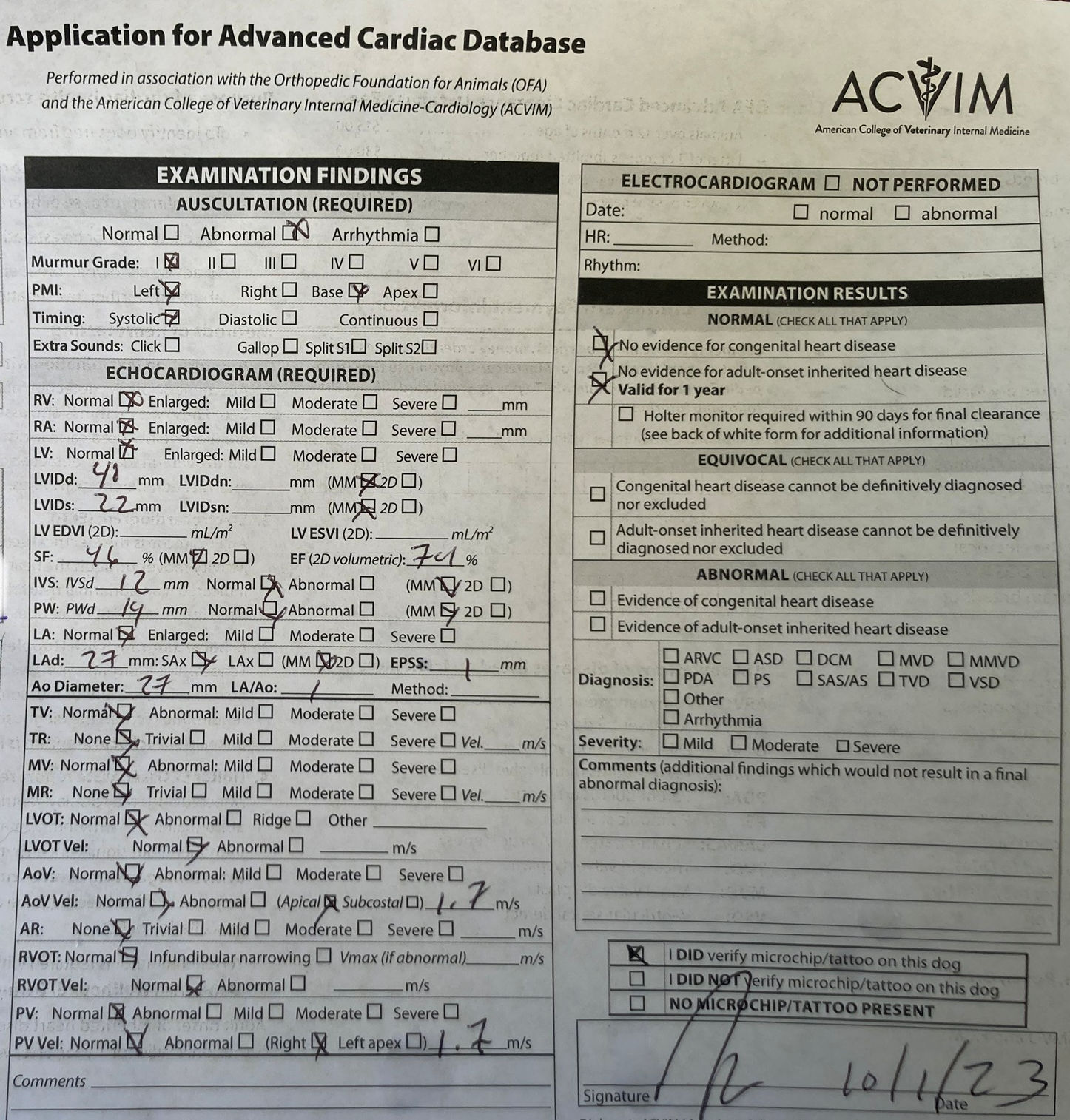
Exam form shows dog with an "innocent murmur" with normal echo and
velocities
Note the line where "Subcostal" is checked off and velocity is 1.7 m/s
click image for bigger
OFA
Advanced Cardiac Cardiac exam
is an auscultation AND echocardiogram by an ACVIM board certified
veterinary cardiologist.
This is the only exam Rottweiler breeders should be doing.
Non cardiologist exams even with echo are not definitive.
Auscultation only exams are not diagnostic for this condition.
(When
reading
the below LVOT/ Aortic Velocity
numbers they are assumed to be accompanied by a clean/normal heart, no
murmur associated with a defect and no abrupt LVOT/aortic velocity
accelerations)
I
base all of my recommendations on conversations with Researchers
from
2000 - 2024, extensive reading of the current and past research, and
conversations with the cardiologists I have personally used over the
past years
since 1995.
NOTE:
there are currently three sets of velocity (LVOT/ Aortic velocity)
unofficial guidelines, detailed below.
With
the dissolution of ARCH, there are NO LONGER any current formal
guidelines or consensus statement that board certified cardiologists
MUST follow.
This is why you will sometimes see a dog receive a "clear" OFA cardiac clearance, when it does not fit any of the below.
Breeders must hold the knowledge themselves, and make the breeding choices that are in the best interest of the breed.
MY IDEAL
-
Rottweilers
"should" only be used for breeding if
LVOT / Aortic Velocity is 1.7 m/s and below for the "best confidence level"
possible.
-
Breeding
dogs
with LVOT 1.71-1.89 m/s will give you
an "element of
risk".
-
Dogs in
1.9
m/s and above range whether the
cardiologist deemed them
"passing" OR "Equivocal BUT with NO cardiac structural defects, LVOT
accelerations, turbulance/regurge, valve leaks or murmurs that
are not deemed "innocent"; brings the "greatest breeding risk"
(only surpassed by dogs not echoed!) and should only be done under
certain VERY strict conditions, with dogs possessing exceptional
qualities and ONLY
ever
bred to dogs with LVOT below 1.7 m/s
MY
personal recommendation at this time, is to ONLY breed echoed dogs with
LVOT/ aortic velocity 1.7 m/s or less. Preferably with
siblings and relatives who have also been echoed and
their LVOT/aortic velocity and the echo reports available for you to
see.
My version
directly above is strict, and provides the highest level of
breeding confidence AT THIS TIME
(until a
DNA test is developed).
The second is the
former ACVIM/ARCH 2011 version
ARCH has been dissolved and the ACVIM did not come to a concensus to
adopt these
In dogs
without
ANY
structural changes, etc and with no murmur (except innocent
functional murmurs)
LVOT Velocities of less than 1.9 m/s - deemed clear
LVOT Velocities of 1.9 - 2.4 m/s - deemed equivocal; breeder assumes a
risk level
LVOT velocities above 2.4 m/s - breeding not recommended
The third is the numbers from Dr
Stern's most recent paper and my most recent (9/2024) conversation with
him
Velocities listed are subcostal readings
Below 1.8 is "certainly normal"
Above 2.5 is "certainly affected"
"Equivocal (2-2.5 m/s; 16-24 mm Hg)
Mild (2.5-3.5 m/s; 25-49 mm Hg)
Moderate (3.5-4.5 m/s; 50-79 mm Hg)
Severe (>4.5 m/s; >80 mm Hg)
I, nor any Rottweiler cardiac researcher
,
do
not recommend breeding a Rottweiler without an echo being performed by
a board certified cardiologist and the
LVOT/ aortic velocity evaluated. (see above)
At
NO
POINT
is
a Practitioner
certification EVER acceptable.
(IF
looking at an OFA cardiac certificate the last letters tell you who did
them
C-ECHO= cardiologist
echo, S-ECHO= specialist
echo
C= cardiologist
auscultation S= specialist
auscultation,
P-ECHO= practitioner
auscultation, P=
practitioner auscultation)
ACA=
advanced cardiac exam and is mandated to be cardiologist performed, but
check the dog's OFA page as some older ACA exams did not include an
echo. All the newer ones do. (you'll see under "conclusion" Normal Ausc
+ Echo)
 Home
Home
 Next
Page
Next
Page
 Our
Rottweilers
Our
Rottweilers